
Volume
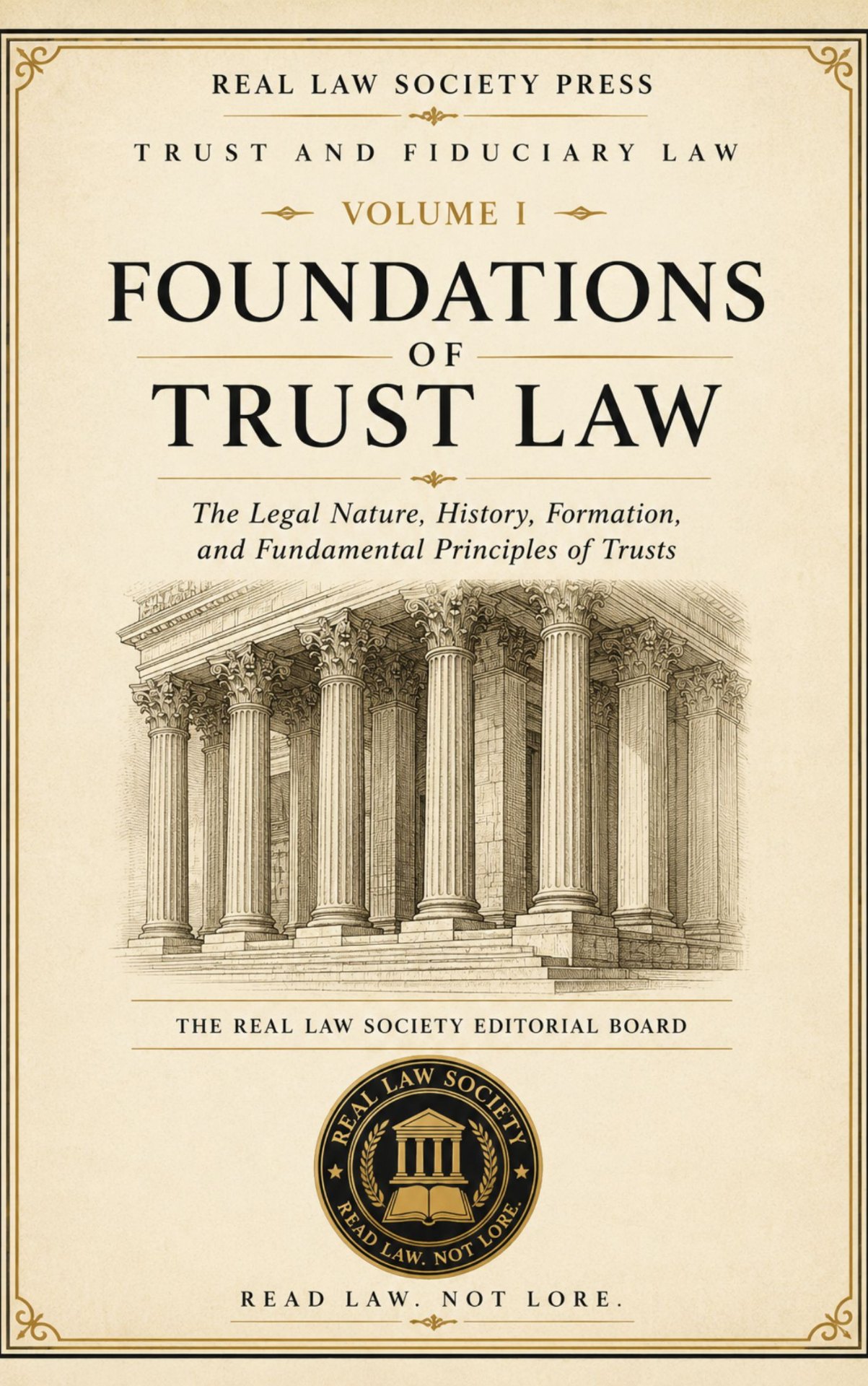
Real Law Society Press
Foundations of Trust Law · Volume I
Foundations of Trust Law
Volume I — Foundations of Trust Law
The doctrinal and historical foundations of the trust relationship: the equitable roots of the trust, the tripartite structure of settlor, trustee, and beneficiary, the substantive elements of creation, the formalities that render a trust cognizable, and the foundational classifications on which every later doctrine rests. Volume I establishes the vocabulary and the equitable premises presupposed by every subsequent volume in the Trust & Fiduciary Law Collection.
- Edition
- First Edition
- Published
- 2026
- Parts
- 9
- Chapters
- 23 of 23 planned
Contents▾
Volume I
Foundations of Trust Law
23 Chapters Published
23 / 23 Complete
Part I
Foundations of the Trust Concept
The definition of the trust, the functions it performs, its equitable character, and its distinction from adjacent legal relationships.
3 Chapters Published
3 / 3 Complete
Part II
Historical Development of Trust Law
The medieval Use through the modern Uniform Trust Code: the historical scaffolding on which every subsequent doctrine rests.
2 Chapters Published
2 / 2 Complete
Part III
The Legal Nature of the Trust
The institutional character of the trust, the two-title conception, and the tripartite relationship among settlor, trustee, and beneficiary.
3 Chapters Published
3 / 3 Complete
Part IV
Creation of a Valid Trust
The five substantive elements of creation: intent, capacity, res, ascertainable beneficiaries, and lawful purpose.
5 Chapters Published
5 / 5 Complete
Part V
Formalities and Evidentiary Requirements
Writing, delivery, and evidentiary requirements for inter vivos and testamentary trusts, and the doctrine of secret and semi-secret trusts.
2 Chapters Published
2 / 2 Complete
Part VI
Foundational Classifications of Trusts
Express, revocable/irrevocable, inter vivos/testamentary, and private/charitable — the foundational classifications of the modern trust landscape.
4 Chapters Published
4 / 4 Complete
Part VII
Non-Express Foundational Trusts
Resulting and constructive trusts — trusts that arise by operation of law rather than by settlor manifestation.
2 Chapters Published
2 / 2 Complete
Part VIII
The Trust–Fiduciary Interface
The trust within the broader fiduciary universe; the doctrinal relationship between trust and fiduciary law.
1 Chapter Published
1 / 1 Complete
Part IX
Transition to Volume II
The doctrinal handoff from foundational doctrine (Volume I) to trust administration and fiduciary duties (Volume II).
1 Chapter Published
1 / 1 Complete
Download
Download the complete volume
Volume I · Reader tools
Download Center
All apparatus is generated automatically from the current published edition. The website remains the definitive online edition.
How to Cite This VolumeReal Law Society Press, Foundations of Trust Law, Volume I — Foundations of Trust Law (2026 ed.), reallawsociety.com/press/series/foundations-of-trust-law.
Table of Authorities
Cases
- Shelley v. KraemerShelley v. Kraemer, 334 U.S. 1 (1948) · Ch. 13
Statutes
- Statute of EnrolmentsStatute of Enrolments, 27 Hen. 8, c. 16 (1536) · Ch. 4
- Statute of FraudsStatute of Frauds, 29 Car. 2, c. 3 (1677) · Ch. 4, Ch. 14
- Statute of UsesStatute of Uses, 27 Hen. 8, c. 10 (1536) · Ch. 7
- Statute of WillsStatute of Wills, 32 Hen. 8, c. 1 (1540) · Ch. 4
Table of Cases
- Beatty v. Guggenheim Exploration Co. — 225 N.Y. 380, 122 N.E. 378 (1919) · Ch. 3, Ch. 21
- Brainard v. Commissioner — 91 F.2d 880 (7th Cir. 1937) · Ch. 11 § 11.02, Ch. 11
- Broadway National Bank v. Adams — 133 Mass. 170 (1882) · Ch. 5 § 5.02, Ch. 5
- Claflin v. Claflin — 149 Mass. 19 (1889) · Ch. 5 § 5.09, Ch. 5
- Clark v. Campbell — 82 N.H. 281, 133 A. 166 (1926) · Ch. 12 § 12.03, Ch. 12
- Clark v. Greenhalge — 411 Mass. 410, 582 N.E.2d 949 (1991) · Ch. 15 § 15.04, Ch. 15
- Clymer v. Mayo — 393 Mass. 754, 473 N.E.2d 1084 (1985) · Ch. 18 § 18.06, Ch. 18
- Farkas v. Williams — 5 Ill. 2d 417, 125 N.E.2d 600 (1955) · Ch. 2, Ch. 2 § 2.03, Ch. 14, Ch. 17, Ch. 17 § 17.07, Ch. 18 § 18.05, Ch. 18
- Guth v. Loft, Inc. — 5 A.2d 503 (Del. 1939) · Ch. 22 § 22.04, Ch. 22
- Harris Trust & Savings Bank v. Salomon Smith Barney Inc. — 530 U.S. 238 (2000) · Ch. 7, Ch. 7 § 7.07
- Harvard College v. Amory — 26 Mass. 446 (1830) · Ch. 5, Ch. 5 § 5.05
- Jimenez v. Lee — 274 Or. 457, 547 P.2d 126 (1976) · Ch. 8, Ch. 8 § 8.06
- Knight v. Knight — 3 Beav. 148, 49 Eng. Rep. 58 (1840) · Ch. 1, Ch. 1 § 1.08, Ch. 9, Ch. 9 § 9.04, Ch. 12, Ch. 16 § 16.01, Ch. 16
- Knight v. Knight, Morice v. Bishop of Durham, Hebrew University Ass'n v. Nye — 148 Conn. 223, 169 A.2d 641 (1961) · Ch. 9 § 9.06, Ch. 9, Ch. 14
- Latham v. Father Divine — 299 N.Y. 22, 85 N.E.2d 168 (1949) · Ch. 21 § 21.04, Ch. 21
- Meinhard v. Salmon — 249 N.Y. 458, 164 N.E. 545 (1928) · Ch. 1, Ch. 1 § 1.16, Ch. 2, Ch. 3, Ch. 22, Ch. 22 § 22.01
- Morice v. Bishop of Durham — 9 Ves. Jr. 399, 32 Eng. Rep. 656 (Ch. 1804) · Ch. 1, Ch. 2, Ch. 9, Ch. 9 § 9.04, Ch. 12 § 12.01, Ch. 12, Ch. 16, Ch. 19 § 19.02, Ch. 19 § 19.01, Ch. 19
- Nichols v. Eaton — 91 U.S. 716 (1875) · Ch. 5 § 5.02, Ch. 5
- Pennsylvania v. Board of Directors of City Trusts — 353 U.S. 230 (1957) · Ch. 13, Ch. 13 § 13.05
- Shelley v. Kraemer — Shelley v. Kraemer, 334 U.S. 1 (1948) · Ch. 13, Ch. 13 § 13.05
- Simonds v. Simonds — 45 N.Y.2d 233, 380 N.E.2d 189 (1978) · Ch. 21, Ch. 21 § 21.06
- Speelman v. Pascal — 10 N.Y.2d 313 (1961) · Ch. 11 § 11.02, Ch. 11
- Unthank v. Rippstein — 386 S.W.2d 134 (Tex. 1964) · Ch. 9, Ch. 9 § 9.03, Ch. 11 § 11.04, Ch. 11
Table of Statutes
England
- Statute of Enrolments, 27 Hen. 8, c. 16 (1536) — Statute of Enrolments
- Statute of Uses, 27 Hen. 8, c. 10 (1536) — Statute of Uses
- Statute of Wills, 32 Hen. 8, c. 1 (1540) — Statute of Wills
England and Wales
- Statute of Frauds, 29 Car. 2, c. 3 (1677) — Statute of Frauds
Subject Index
- Active and Passive Trusts — Ch. 7 § 7.08
- Adjacent Grounds for Avoidance — Undue Influence, Duress, Fraud, and Mistake — Ch. 10 § 10.07
- Administration — Ch. 23
- Advancement — Ch. 20
- Advancing to Volume II — Trust Administration and Fiduciary Duties — Ch. 23
- After-Acquired Property and Pour-Over Funding — Ch. 11 § 11.06
- Age and Guardianship as Legal Thresholds — Ch. 10 § 10.05
- Agency-cost — Ch. 6
- American-legal-history — Ch. 5
- Attorney-general — Ch. 19
- Beneficiaries — Ch. 12
- Beneficiary — Ch. 8
- Beneficiary Remedies — Survey — Ch. 23 § 23.05
- Beneficiary-principle — Ch. 12, Ch. 19
- Bona-fide-purchaser — Ch. 7
- Breach of Fiduciary Duty — Ch. 21 § 21.05
- Burden of Proof and Suspicious Circumstances — Ch. 10 § 10.08
- Canonical Part Structure Applied — Ch. 1, Ch. 2, Ch. 3, Ch. 4, Ch. 5, Ch. 6, Ch. 7, Ch. 8, Ch. 9, Ch. 10, Ch. 11, Ch. 12, Ch. 13, Ch. 14, Ch. 15, Ch. 16, Ch. 17, Ch. 18, Ch. 19, Ch. 20, Ch. 21, Ch. 22, Ch. 23
- Capacity — Ch. 10
- Capacity as a Validity Requirement — Ch. 10 § 10.01
- Capacity for Irrevocable Inter Vivos Trusts — Ch. 10 § 10.02
- Capacity for Revocable Inter Vivos Trusts — UTC § 601 — Ch. 10 § 10.04
- Capacity for Testamentary Trusts — Ch. 10 § 10.03
- Care — Ch. 22
- Categories of Property That May Serve as Res — Ch. 11 § 11.03
- Certainty of Objects — Discretionary Trusts — Ch. 12 § 12.04
- Certainty of Objects — Fixed-Interest Trusts — Ch. 12 § 12.03
- Certainty-of-objects — Ch. 12
- Chancery — Ch. 3
- Chancery's Protection of the Cestui que Use — Ch. 4 § 4.03
- Chapter Apparatus — Ch. 1, Ch. 2, Ch. 3, Ch. 4, Ch. 5, Ch. 6, Ch. 7, Ch. 8, Ch. 9, Ch. 10, Ch. 11, Ch. 12, Ch. 13, Ch. 14, Ch. 15, Ch. 16, Ch. 17, Ch. 18, Ch. 19, Ch. 20, Ch. 21, Ch. 22, Ch. 23
- Chapter Purpose — Ch. 1, Ch. 2, Ch. 3, Ch. 4, Ch. 5, Ch. 6, Ch. 7, Ch. 8, Ch. 9, Ch. 10, Ch. 11, Ch. 12, Ch. 13, Ch. 14, Ch. 15, Ch. 16, Ch. 17, Ch. 18, Ch. 19, Ch. 20, Ch. 21, Ch. 22, Ch. 23
- Charitable Purposes at Foundational Depth — Ch. 2 § 2.08
- Charitable-trusts — Ch. 2, Ch. 13, Ch. 19
- Choice of Law and Jurisdiction — Survey — Ch. 23 § 23.07
- Class Designations and Powers of Selection — Ch. 12 § 12.05
- Classification — Ch. 16, Ch. 17, Ch. 18, Ch. 19, Ch. 20
- Closing of Volume I — Ch. 23
- Co-trustees — Ch. 8
- Colonial and Post-Revolutionary Reception — Ch. 5 § 5.01
- Comparative Recognition and the Hague Convention — Ch. 6 § 6.09
- Consequences — Transfer Taxation, Creditor Access, and Beneficiary Standing — Ch. 18 § 18.08
- Consequences for Creditors and Third Parties — Ch. 17 § 17.06
- Consequences of Failure for Want of Ascertainable Beneficiaries — Ch. 12 § 12.10
- Consequences of Purpose Failure — Ch. 13 § 13.11
- Constructive-trusts — Ch. 21
- Contractarian — Ch. 6
- Contravention of Public Policy — Ch. 13 § 13.04
- Coordination — The Pour-Over Will and the Uniform Testamentary Additions to Trusts Act — Ch. 18 § 18.06
- Corporate, Agency, and Professional Fiduciaries — Ch. 22 § 22.07
- Corrective Doctrines — Ch. 13 § 13.08
- Creation — Ch. 9, Ch. 9 § 9.05, Ch. 10, Ch. 11, Ch. 12, Ch. 13, Ch. 14, Ch. 15
- Creation — Adoption of Extrinsic Content — Ch. 15 § 15.04
- Creation — Class Designations and Enforcement — Ch. 12 § 12.05
- Creation — Legal Thresholds and Moment of Manifestation — Ch. 10 § 10.05
- Creation — Restrictive Conditions in the Modern Law — Ch. 13 § 13.05
- Creation — Special Doctrinal Problems — Ch. 11 § 11.04
- Creation — The Elements of Formality — Ch. 14 § 14.05
- Creation — The Interaction of the Two Forms — Ch. 18 § 18.06
- Creation (by Operation of Law) — Ch. 20 § 20.04, Ch. 21 § 21.04
- Creation (Foundational Level) — Ch. 1 § 1.12
- Cross-References — Ch. 1, Ch. 2, Ch. 3, Ch. 4, Ch. 5, Ch. 6, Ch. 7, Ch. 8, Ch. 9, Ch. 10, Ch. 11, Ch. 12, Ch. 13, Ch. 14, Ch. 15, Ch. 16, Ch. 17, Ch. 18, Ch. 19, Ch. 20, Ch. 21, Ch. 22, Ch. 23
- Cy-pres — Ch. 13, Ch. 19
- Declaration-of-trust — Ch. 14
- Defenses — Ch. 10 § 10.07
- Defenses — Failure of the Res — Ch. 11 § 11.08
- Defenses (Foundational) — Ch. 9 § 9.09
- Defenses / Corrective Doctrines — Ch. 14 § 14.10, Ch. 15 § 15.07
- Defenses to Manifested Intent — Mistake, Undue Influence, Fraud, Incapacity — Ch. 9 § 9.09
- Delivery and Effective Transfer — Ch. 14 § 14.07
- Distinctive American Doctrinal Developments — Ch. 5 § 5.02
- Distinguished from Express and Constructive Trusts — Ch. 20 § 20.03
- Distinguished from Express and Resulting Trusts — Ch. 21 § 21.03
- Doctrinal Boundaries — Agency, Bailment, Contract, Debt, and the Corporate Form — Ch. 6 § 6.03
- Doctrinal Consequences of a Successful Capacity Challenge — Ch. 10 § 10.09
- Enforcement (Foundational) — Ch. 3 § 3.06, Ch. 7 § 7.06, Ch. 8 § 8.09, Ch. 21 § 21.07
- Enforcement by the Attorney General; Perpetuities Exemption; Federal Transfer-Tax Treatment — Ch. 19 § 19.06
- Equitable Deviation and Cy Pres — Ch. 13 § 13.08
- Equitable Remedies as Trust Remedies — Ch. 3 § 3.06
- Equitable Tracing and the Proprietary Character of the Beneficiary's Interest — Ch. 7 § 7.07
- Equitable-deviation — Ch. 13
- Equitable-title — Ch. 7
- Equity — Ch. 1, Ch. 2, Ch. 3, Ch. 4
- Equity Acts In Personam — Ch. 3 § 3.03
- Equity and the Broader Fiduciary Universe — Ch. 3 § 3.08
- Exceptions to the Beneficiary Principle — Ch. 12 § 12.06
- Expectancies and Future Interests — Ch. 11 § 11.04
- Express Trusts Distinguished from Resulting and Constructive Trusts (Preview) — Ch. 16 § 16.05
- Express-trusts — Ch. 16
- Facts of Independent Significance — Ch. 15 § 15.05
- Failure of Express Trust — Ch. 20 § 20.05
- Failure of the Res — Ch. 11 § 11.08
- Farkas v. Williams and the Doctrinal Validation of the Revocable Inter Vivos Trust — Ch. 18 § 18.05
- Farkas-v-williams — Ch. 17
- Fiduciary-duties — Ch. 23
- Fiduciary-law — Ch. 1, Ch. 2, Ch. 3, Ch. 22
- Formalities — Ch. 14, Ch. 15
- Formalities and Trust Validity — The Consequences of Failure — Ch. 14 § 14.11, Ch. 15 § 15.10
- Formalities as an Evidentiary Requirement — Ch. 14 § 14.01
- Foundational — Ch. 1, Ch. 2, Ch. 3, Ch. 4, Ch. 5, Ch. 6, Ch. 7, Ch. 8, Ch. 9, Ch. 10, Ch. 11, Ch. 12, Ch. 13, Ch. 14, Ch. 15, Ch. 16, Ch. 17, Ch. 18, Ch. 19, Ch. 20, Ch. 21, Ch. 22, Ch. 23
- Foundations — Ch. 1 § 1.01, Ch. 2 § 2.01, Ch. 3 § 3.01, Ch. 16 § 16.01, Ch. 17 § 17.01, Ch. 20 § 20.01, Ch. 21 § 21.01, Ch. 22 § 22.01, Ch. 23 § 23.01
- Foundations (Doctrinal-Institutional) — Ch. 9 § 9.01, Ch. 10 § 10.01, Ch. 11 § 11.01, Ch. 12 § 12.01, Ch. 13 § 13.01, Ch. 14 § 14.01, Ch. 15 § 15.01, Ch. 18 § 18.01, Ch. 19 § 19.01
- Foundations (Historical-Institutional) — Ch. 5 § 5.01, Ch. 7 § 7.01
- Foundations (Historical) — Ch. 4 § 4.01
- Foundations (Institutional) — Ch. 6 § 6.01, Ch. 8 § 8.01
- Fraud, Undue Influence, and Duress — Ch. 21 § 21.04
- From Creation to Administration — Ch. 23 § 23.02
- Function Distinguished from Purpose — Ch. 2 § 2.02
- Funding — Ch. 11
- Funding, Administration, and Probate Coordination — Ch. 18 § 18.07
- Heggstad — Ch. 14
- Historical Development — From the Medieval Use to the Modern American Revocable Trust — Ch. 18 § 18.02
- Honorary-trusts — Ch. 19
- How a Trust Operates Once Created — Ch. 1 § 1.14
- How the Reader Moves from Volume I to Volume II — Ch. 23 § 23.09
- Illegality — Ch. 13 § 13.03
- Impartiality, Information, and Accounting — Ch. 22 § 22.06
- Impossibility and Impracticability — Ch. 13 § 13.07
- Incomplete Disposition of the Beneficial Interest — Ch. 20 § 20.06
- Incorporation by Reference — Ch. 15 § 15.04
- Institutional Continuity — Ch. 2 § 2.06
- Institutional-analysis — Ch. 6
- Intent — Ch. 9
- Intent in Resulting and Constructive Trusts — Ch. 9 § 9.10
- Inter-vivos-trusts — Ch. 14, Ch. 18
- Keech — Ch. 22
- Key Principles — Ch. 1, Ch. 2, Ch. 3, Ch. 4, Ch. 5, Ch. 6, Ch. 7, Ch. 8, Ch. 9, Ch. 10, Ch. 11, Ch. 12, Ch. 13, Ch. 14, Ch. 15, Ch. 16, Ch. 17, Ch. 18, Ch. 19, Ch. 20, Ch. 21, Ch. 22, Ch. 23
- Lawful Purpose as a Validity Requirement — Ch. 13 § 13.01
- Legal and Equitable Title as Equitable Constructs — Ch. 3 § 3.05
- Legal Nature — Ch. 1 § 1.04, Ch. 3 § 3.03, Ch. 8 § 8.02, Ch. 9 § 9.02, Ch. 16 § 16.02, Ch. 17 § 17.02, Ch. 20 § 20.02, Ch. 21 § 21.02, Ch. 22 § 22.02, Ch. 23 § 23.02
- Legal Nature — Categories of Unlawful Purpose — Ch. 13 § 13.02
- Legal Nature — Certainty of Objects — Ch. 12 § 12.03
- Legal Nature — Content of the Res Requirement — Ch. 11 § 11.02
- Legal Nature — The Charitable Purpose — Ch. 19 § 19.03
- Legal Nature — The Modes of Creation — Ch. 14 § 14.02
- Legal Nature — The Two Capacity Standards — Ch. 10 § 10.02
- Legal Nature — The Two Forms — Ch. 18 § 18.03
- Legal Nature — Wills Act Formalities — Ch. 15 § 15.02
- Legal Nature (Functional Analysis) — Ch. 2 § 2.03
- Legal Nature (Historical — Institutional Consolidation) — Ch. 5 § 5.03
- Legal Nature (Historical) — Ch. 4 § 4.03
- Legal Nature (Incidents of the Two Titles) — Ch. 7 § 7.03
- Legal Nature (Institutional Boundaries) — Ch. 6 § 6.03
- Legal-history — Ch. 4, Ch. 5
- Legal-nature — Ch. 6, Ch. 7, Ch. 8
- Legal-title — Ch. 7
- Loyalty — Ch. 22
- Management for Persons Who Cannot Manage — Ch. 2 § 2.04
- Manifestation — Ch. 9
- Manifestation Distinguished from Subjective Intent — Ch. 9 § 9.02
- Mechanics of Revocation and Modification — Ch. 17 § 17.05
- Medieval-uses — Ch. 4
- Meinhard — Ch. 22
- Mental Capacity as of the Moment of Manifestation — Ch. 10 § 10.06
- Modern Participants: Directors, Protectors, and Advisors — Ch. 8 § 8.10
- Modes of Manifestation — Declaration, Transfer, Testamentary — Ch. 9 § 9.05
- Modification and Termination — Survey — Ch. 23 § 23.06
- Multiple Beneficiaries and Successive Interests — Foundational Treatment — Ch. 8 § 8.08
- Multiple Trustees — Foundational Treatment — Ch. 8 § 8.07
- Noncharitable Purpose Trusts and Honorary Trusts — Ch. 19 § 19.07
- Nonprobate-revolution — Ch. 18
- Notice, Acceptance, and the Trustee's Role — Ch. 14 § 14.09
- Operation (Foundational Level) — Ch. 1 § 1.14
- Operation (Foundational) — Ch. 14 § 14.09, Ch. 18 § 18.07, Ch. 19 § 19.05
- Operation-of-law — Ch. 20, Ch. 21
- Oral Manifestations and the Formalities Interface — Ch. 9 § 9.06
- Oral Trusts of Personal Property — Ch. 14 § 14.04
- Overlap of Roles — Ch. 8 § 8.05
- Part Performance and Equitable Exceptions — Ch. 14 § 14.10
- Partial Interests, Segregation, and Identification — Ch. 11 § 11.05
- Partial Invalidity and Severance — Ch. 13 § 13.10
- Pemsel — Ch. 19
- Pet-trusts — Ch. 12
- Pour-over — Ch. 11
- Pour-over-wills — Ch. 15, Ch. 18
- Practical Application (Transitional) — Ch. 23 § 23.09
- Precatory — Ch. 9
- Precatory Language — Ch. 9 § 9.03
- Primary Authorities — Ch. 1, Ch. 2, Ch. 3, Ch. 4, Ch. 5, Ch. 6, Ch. 7, Ch. 8, Ch. 9, Ch. 10, Ch. 11, Ch. 12, Ch. 13, Ch. 14, Ch. 15, Ch. 16, Ch. 17, Ch. 18, Ch. 19, Ch. 20, Ch. 21, Ch. 22, Ch. 23
- Primary Authorities Cited in This Chapter — Ch. 1, Ch. 2, Ch. 3, Ch. 4, Ch. 5, Ch. 6, Ch. 7, Ch. 8, Ch. 9, Ch. 10, Ch. 11, Ch. 12, Ch. 13, Ch. 14, Ch. 15, Ch. 16, Ch. 17, Ch. 18, Ch. 19, Ch. 20, Ch. 21, Ch. 22, Ch. 23
- Principal Research Sources — Ch. 1, Ch. 2, Ch. 3, Ch. 4, Ch. 5, Ch. 6, Ch. 7, Ch. 8, Ch. 9, Ch. 10, Ch. 11, Ch. 12, Ch. 13, Ch. 14, Ch. 15, Ch. 16, Ch. 17, Ch. 18, Ch. 19, Ch. 20, Ch. 21, Ch. 22, Ch. 23
- Private-trusts — Ch. 19
- Property-law — Ch. 1
- Proprietary — Ch. 6
- Prudent-investor — Ch. 22
- Prudent-investor-rule — Ch. 5
- Public-policy — Ch. 13
- Purchase-money — Ch. 20
- Purchase-Money Resulting Trust — Ch. 20 § 20.04
- Purpose — Ch. 13
- Purpose-trusts — Ch. 12, Ch. 19
- Racial and Comparable Discriminatory Purposes — Ch. 13 § 13.05
- Reader Orientation — Ch. 1, Ch. 2, Ch. 3, Ch. 4, Ch. 5, Ch. 6, Ch. 7, Ch. 8, Ch. 9, Ch. 10, Ch. 11, Ch. 12, Ch. 13, Ch. 14, Ch. 15, Ch. 16, Ch. 17, Ch. 18, Ch. 19, Ch. 20, Ch. 21, Ch. 22, Ch. 23
- Related Chapters — Ch. 1, Ch. 2, Ch. 3, Ch. 4, Ch. 5, Ch. 6, Ch. 7, Ch. 8, Ch. 9, Ch. 10, Ch. 11, Ch. 12, Ch. 13, Ch. 14, Ch. 15, Ch. 16, Ch. 17, Ch. 18, Ch. 19, Ch. 20, Ch. 21, Ch. 22, Ch. 23
- Related Doctrines — Ch. 1 § 1.16, Ch. 2 § 2.09, Ch. 3 § 3.08, Ch. 9 § 9.10, Ch. 15 § 15.10, Ch. 16 § 16.05, Ch. 17 § 17.07, Ch. 18 § 18.09, Ch. 19 § 19.07, Ch. 20 § 20.07, Ch. 21 § 21.08, Ch. 22 § 22.07, Ch. 23 § 23.06
- Related Doctrines (Comparative) — Ch. 6 § 6.09
- Related Doctrines (Federal Interfaces and State Variation) — Ch. 5 § 5.08
- Related Doctrines (Historical Residue) — Ch. 7 § 7.08
- Related Doctrines (Historiographical) — Ch. 4 § 4.07
- Religious, Marital, and Comparable Personal-Life Restrictions — Ch. 13 § 13.06
- Res — Ch. 11
- Resolving the Discrepancy — Choice of Law and Governing Instrument — Ch. 17 § 17.04
- Restatement-third-of-trusts — Ch. 1, Ch. 3, Ch. 5
- Restitution — Ch. 21
- Resulting-trusts — Ch. 20
- Revocable-trust — Ch. 2, Ch. 10
- Revocable-trusts — Ch. 17, Ch. 18
- Rights and Duties (Foundational Level) — Ch. 1 § 1.15
- Rights and Duties (Foundational) — Ch. 6 § 6.08, Ch. 8 § 8.07, Ch. 17 § 17.05, Ch. 22 § 22.04
- Rights and Duties (Handoff) — Ch. 23 § 23.03
- Risk Management and Creditor Considerations — Ch. 2 § 2.07
- Scholarly Accounts of the Origin and Survival of the Use — Ch. 4 § 4.07
- Secondary Authorities Cited in This Chapter — Ch. 1, Ch. 2, Ch. 3, Ch. 4, Ch. 5, Ch. 6, Ch. 7, Ch. 8, Ch. 9, Ch. 10, Ch. 11, Ch. 12, Ch. 13, Ch. 14, Ch. 15, Ch. 16, Ch. 17, Ch. 18, Ch. 19, Ch. 20, Ch. 21, Ch. 22
- Secret Trusts — The Classical Doctrine — Ch. 15 § 15.07
- Secret-trusts — Ch. 15
- Semi-Secret Trusts and the Differential Remedial Question — Ch. 15 § 15.08
- Semi-secret-trusts — Ch. 15
- Separation of Ownership from Enjoyment — Ch. 2 § 2.05
- Settlor — Ch. 8
- Spendthrift-trust — Ch. 5
- Standing — Ch. 8
- Standing to Enforce the Trust — Foundational Treatment — Ch. 8 § 8.09
- State Enactment, Variation, and Federal Interfaces — Ch. 5 § 5.08
- Statute-of-frauds — Ch. 4, Ch. 9, Ch. 14
- Statute-of-uses — Ch. 4, Ch. 7
- Statute-of-wills — Ch. 4
- Statutory Pet and Purpose Trusts — Ch. 12 § 12.08
- Sub-Classifications of Express Trusts — Ch. 16 § 16.03
- Testamentary-capacity — Ch. 10
- Testamentary-trusts — Ch. 15, Ch. 18
- The Agency-Cost Characterization of the Trust — Sitkoff — Ch. 6 § 6.06
- The Beneficiary Principle — Ch. 12 § 12.01
- The Beneficiary Principle — Morice v. Bishop of Durham — Ch. 19 § 19.02
- The Beneficiary-Ascertainability Exception — Ch. 19 § 19.05
- The Beneficiary's Role — Ch. 8 § 8.04
- The Chancery Jurisdiction in Outline — Ch. 3 § 3.02
- The Charitable-Trust Exception — Ch. 12 § 12.06
- The Classification as a Distinction of Substance — Ch. 19 § 19.01
- The Classification as a Distinction of Timing — Ch. 18 § 18.01
- The Constructive Trust in Outline — Ch. 21 § 21.01
- The Continuing Significance of Divided Title in Modern Trust Law — Ch. 7 § 7.09
- The Contractarian Characterization of the Trust — Langbein — Ch. 6 § 6.05
- The Coordination of Restatement, Code, and State Common Law — Ch. 5 § 5.10
- The Default/Mandatory Architecture — UTC § 105 — Ch. 6 § 6.08
- The Definition of Charitable Purpose — Ch. 19 § 19.03
- The Doctrinal Foundation Established in Volume I — Ch. 23 § 23.01
- The Duty of Care — Ch. 22 § 22.05
- The Duty of Loyalty — Ch. 22 § 22.04
- The Emergence of the Use — Ch. 4 § 4.02
- The Enforceability of Equitable Title Against Third Parties — Bona Fide Purchaser — Ch. 7 § 7.06
- The Enforcement Mechanism — Ch. 12 § 12.09
- The Enforcement Rationale — Ch. 12 § 12.02
- The Equitable Character of the Trust — Ch. 1 § 1.11
- The Equitable Justification — Fraud, Unjust Enrichment, and the Wills Act's Integrity — Ch. 15 § 15.09
- The Equitable Maxims Governing Trusts — Ch. 3 § 3.04
- The Essential Elements at a Glance — Ch. 1 § 1.13
- The Express Trust as Default — Ch. 16 § 16.04
- The Express Trust in Outline — Ch. 16 § 16.01
- The Express Trust in Practice — Ch. 16 § 16.06
- The Feudal Landholding Background — Ch. 4 § 4.01
- The First and Second Restatements of Trusts (1935, 1959) — Ch. 5 § 5.05
- The Foundational/Operational Boundary — What Is Reserved for Volume II — Ch. 19 § 19.08
- The Four Pemsel Heads — Ch. 19 § 19.04
- The Four Purpose Defects — Ch. 13 § 13.02
- The Functional Literature and Its Limits — Ch. 2 § 2.09
- The Functions of Trusts — Ch. 1 § 1.02
- The Harmless-Error Rule and the Reach of Modern Doctrine — Ch. 15 § 15.03
- The Heggstad Line — Declarations Without Retitling — Ch. 14 § 14.08
- The Historical Origin of Divided Ownership — Ch. 7 § 7.01
- The Honorary-Trust Exception — Ch. 12 § 12.07
- The Incidents of Equitable Title — The Beneficiary as Equitable Owner — Ch. 7 § 7.04
- The Incidents of Legal Title — The Trustee as Legal Owner — Ch. 7 § 7.03
- The Institutional Adaptability of the Trust — Ch. 6 § 6.07
- The Intent Element as Constitutive — Ch. 9 § 9.01
- The Inter Vivos Trust — Definition and Modes of Creation — Ch. 18 § 18.03
- The Medieval Vocabulary and Its Modern Residue — Ch. 4 § 4.06
- The Modification-and-Termination Controversy — Ch. 5 § 5.09
- The Nineteenth-Century Treatise Tradition — Story and Perry — Ch. 5 § 5.03
- The Nonprobate Revolution and the Ascendancy of the Funded Revocable Trust — Ch. 18 § 18.09
- The Presumption of Advancement and Its Modern Critique — Ch. 20 § 20.07
- The Private/Charitable Purpose Distinction — Ch. 13 § 13.09
- The Prohibition on Sole Trustee/Sole Beneficiary — Ch. 8 § 8.06
- The Proprietary Characterization of the Trust — Scott, Bogert, and the Restatement (Third) — Ch. 6 § 6.04
- The Res as a Validity Requirement — Ch. 11 § 11.01
- The Res as the Object of the Dual-Title Structure — Ch. 11 § 11.09
- The Res Requirement in Summary — Ch. 11 § 11.10
- The Restatement (Third) and Uniform Trust Code Treatment — Ch. 11 § 11.07
- The Restatement (Third) of Trusts (2003–2012) — Ch. 5 § 5.06
- The Resulting Trust in Outline — Ch. 20 § 20.01
- The Revocable Trust as Will Substitute — Ch. 17 § 17.07
- The Revocable/Irrevocable Distinction in Outline — Ch. 17 § 17.01
- The Separation of Ownership and Control — Ch. 7 § 7.05
- The Settlor's Manifestation as Constitutive — Ch. 16 § 16.02
- The Settlor's Role — Ch. 8 § 8.02
- The Signature Requirement and Electronic Execution — Ch. 14 § 14.06
- The Statute of Frauds and Trusts of Real Property — Ch. 14 § 14.03
- The Statute of Uses (1535/1536) — Ch. 4 § 4.04
- The Survival of Equity in Fused Systems — Ch. 3 § 3.07
- The Testamentary Trust — Definition and Mode of Creation — Ch. 18 § 18.04
- The Three Certainties — Ch. 9 § 9.04
- The Traditional Presumption of Irrevocability — Ch. 17 § 17.02
- The Tripartite Content — Identifiability, Existence, Transferability — Ch. 11 § 11.02
- The Tripartite Relationship — Ch. 1 § 1.15
- The Tripartite Structure — Ch. 8 § 8.01
- The Trust and Fiduciary Law — Ch. 22 § 22.01
- The Trust and the Broader Fiduciary Universe — Ch. 1 § 1.16
- The Trust as a Legal Institution — Ch. 1 § 1.04
- The Trust as a Legal Technology — Ch. 2 § 2.01
- The Trust as a Relationship, Not a Person — Ch. 6 § 6.01
- The Trust as a Relationship, Not an Entity — Ch. 6 § 6.02
- The Trust as Paradigmatic Fiduciary Relationship — Ch. 22 § 22.02
- The Trust Defined — Ch. 1 § 1.01
- The Trustee's Role — Ch. 8 § 8.03
- The Twentieth-Century Treatise Tradition — Bogert and Scott — Ch. 5 § 5.04
- The Two Modes: Declaration and Transfer — Ch. 14 § 14.02
- The U.S. Restatement of Restitution vs. Commonwealth Approaches — Ch. 21 § 21.08
- The Uniform Testamentary Additions to Trusts Act and the Pour-Over Will — Ch. 15 § 15.06
- The Uniform Trust Code (2000, with Amendments) — Ch. 5 § 5.07
- The Use Upon a Use and the Emergence of the Modern Trust — Ch. 4 § 4.05
- The UTC § 602 Presumption of Revocability — Ch. 17 § 17.03
- The Vocabulary of Trust Law — Ch. 1 § 1.03
- The Wills Act as the Governing Formalities Regime — Ch. 15 § 15.01
- The Writing Requirement — Content and Sufficiency — Ch. 14 § 14.05
- Three-certainties — Ch. 9, Ch. 16
- Timing of Manifestation — Ch. 9 § 9.07
- Tracing — Ch. 7, Ch. 21
- Tracing and Following — Foundational — Ch. 21 § 21.07
- Transition — Ch. 23
- Transition to Chapter 10 — Ch. 9
- Transition to Chapter 11 — Ch. 10
- Transition to Chapter 12 — Ch. 11
- Transition to Chapter 13 — Ch. 12
- Transition to Chapter 14 — Ch. 13
- Transition to Chapter 15 — Ch. 14
- Transition to Chapter 16 — Ch. 15
- Transition to Chapter 17 — Ch. 16
- Transition to Chapter 18 — Ch. 17
- Transition to Chapter 19 — Ch. 18
- Transition to Chapter 2 — Ch. 1
- Transition to Chapter 20 — Ch. 19
- Transition to Chapter 21 — Ch. 20
- Transition to Chapter 23 — Ch. 22
- Transition to Chapter 3 — Ch. 2
- Transition to Chapter 4 — Ch. 3
- Transition to Chapter 5 — Ch. 4
- Transition to Chapter 6 — Ch. 5
- Transition to Chapter 7 — Ch. 6
- Transition to Chapter 8 — Ch. 7
- Transition to Chapter 9 — Ch. 8
- Transition to Part Eight — Ch. 21
- Tripartite-relationship — Ch. 8
- Trust by Operation of Law — Not by Manifestation — Ch. 20 § 20.02
- Trust Distinguished from Agency — Ch. 1 § 1.05
- Trust Distinguished from Bailment — Ch. 1 § 1.06
- Trust Distinguished from Contract — Ch. 1 § 1.07
- Trust Distinguished from Corporate and Other Entity Forms — Ch. 1 § 1.10
- Trust Distinguished from Gift — Ch. 1 § 1.08
- Trust Distinguished from Guardianship and Custodianship — Ch. 1 § 1.09
- Trust Intent Distinguished from Contractual and Testamentary Intent — Ch. 9 § 9.08
- Trust or Remedy? — The Characterization Debate — Ch. 21 § 21.02
- Trust-law — Ch. 1, Ch. 2, Ch. 3, Ch. 4, Ch. 5, Ch. 6, Ch. 7, Ch. 8, Ch. 9, Ch. 10, Ch. 11, Ch. 12, Ch. 13, Ch. 14, Ch. 15, Ch. 16, Ch. 17, Ch. 18, Ch. 19, Ch. 20, Ch. 21, Ch. 22, Ch. 23
- Trust-property — Ch. 11
- Trustee — Ch. 8
- Trustee Duties — Survey — Ch. 23 § 23.04
- Trustee Powers — Survey — Ch. 23 § 23.03
- Undue-influence — Ch. 10
- Unified vs. Family-of-Doctrines Accounts — Ch. 22 § 22.03
- Uniform-trust-code — Ch. 1, Ch. 3, Ch. 5
- Unjust Enrichment as a General Basis — Ch. 21 § 21.06
- Unjust-enrichment — Ch. 21
- Utata — Ch. 15, Ch. 18
- Utc-105 — Ch. 6
- Utc-602 — Ch. 17
- Volume III and Beyond — Preview — Ch. 23 § 23.08
- Volume-ii — Ch. 23
- Wealth Transmission Across Time — Ch. 2 § 2.03
- Wealth-transmission — Ch. 2
- What "Equitable" Means in Trust Law — Ch. 3 § 3.01
- What It Means to Create a Trust — Ch. 1 § 1.12
- Why Equity Recognized Beneficial Ownership — Ch. 7 § 7.02
- Will-substitute — Ch. 17
- Wills-act — Ch. 15
- Writing, Signature, and Attestation — Ch. 15 § 15.02
Citation
How to cite this volume
Long form
Real Law Society Press, Foundations of Trust Law, Volume I of Foundations of Trust Law (First Edition, 2026).
Short form
Foundations of Trust Law vol. I
Reading Room
Continue reading
Reading progress for every chapter of this volume is tracked automatically by the Real Law Society Reading Room. Signed-in members can resume where they left off, save chapters to personal reading lists, and see the volume marked complete when every chapter has been read.
Authority & methodology
Editorial standards governing this volume
Every chapter in Volume I is prepared under the Real Law Society Press editorial framework: the Editorial Constitution, the Canonical Treatise Architecture, the Editorial Manual, the Legal Research Methodology Manual, and the House Style Guide. Primary authorities are cited before Restatement guidance; Restatement guidance is cited before secondary commentary; historical materials are cited where they clarify the doctrinal record.
Scope
Institutional scope notice
This publication is an educational treatise of the Real Law Society Press. It is not legal advice, does not create an attorney–client relationship, and does not opine on the law of any particular jurisdiction.